ADI-2/4 Pro EX
2-AD/4-DA 768 kHz, High-Performance Converter
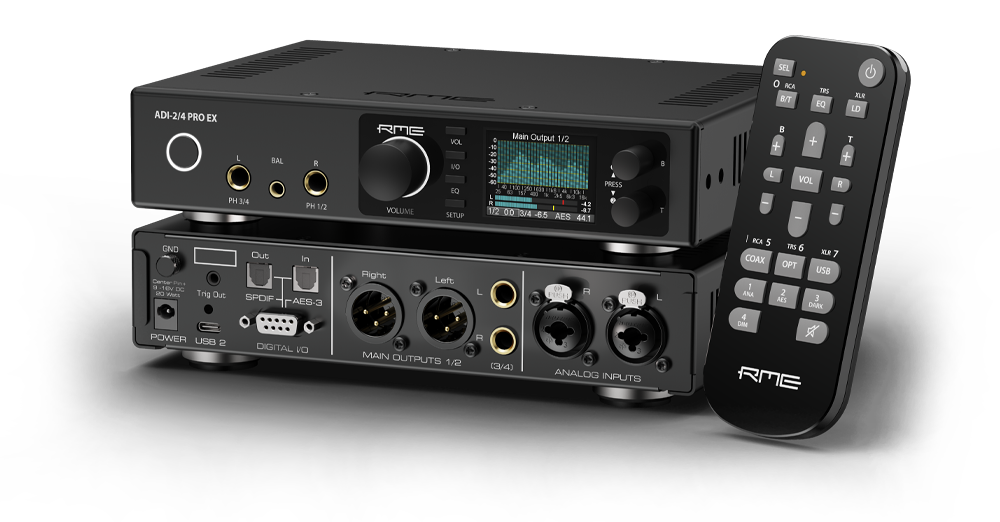
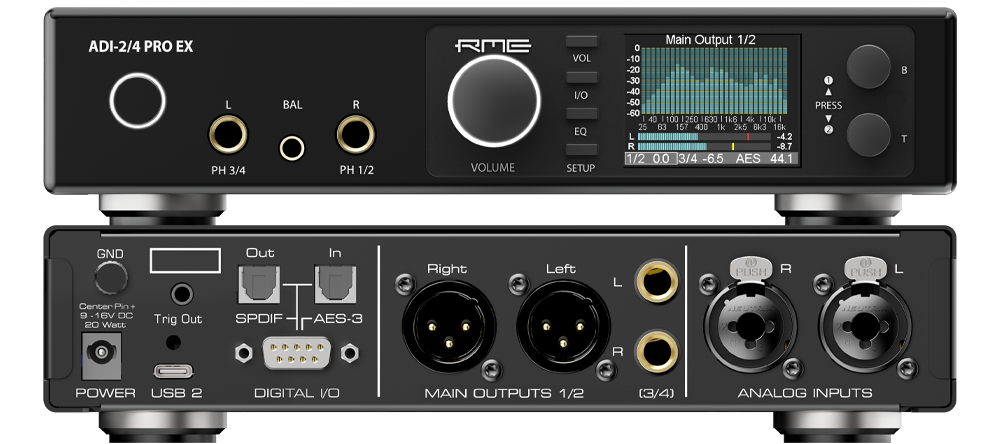
Connectivity and Features

2 x Phono/Line input

1 x ADAT I/O

1 x SPDIF I/O

1 x AES I/O

RME USB-C

1 x Phones or Balanced Pentaconn

4 x Line Output

Class Compliant Mode

Remote

SteadyClock EX

DC-coupled Outputs
RME's latest AD/DA converter is:
- A high-end AD/DA converter in professional studio quality
- A double headphone amplifier in true high-end quality
- A USB DAC like no other - the most versatile and capable one around
- A high-end AD/DA frontend and headphone amp for iPad and iPhone
- An AD/DA frontend for measurement systems at up to 768 kHz sample rate
- A multi-format converter (AES, SPDIF, ADAT) with monitoring
- An SPDIF/ADAT playback system
- A DSD record and playback solution
- A vinyl player digitizing solution on highest level
A Multitude of Devices compressed in one Housing
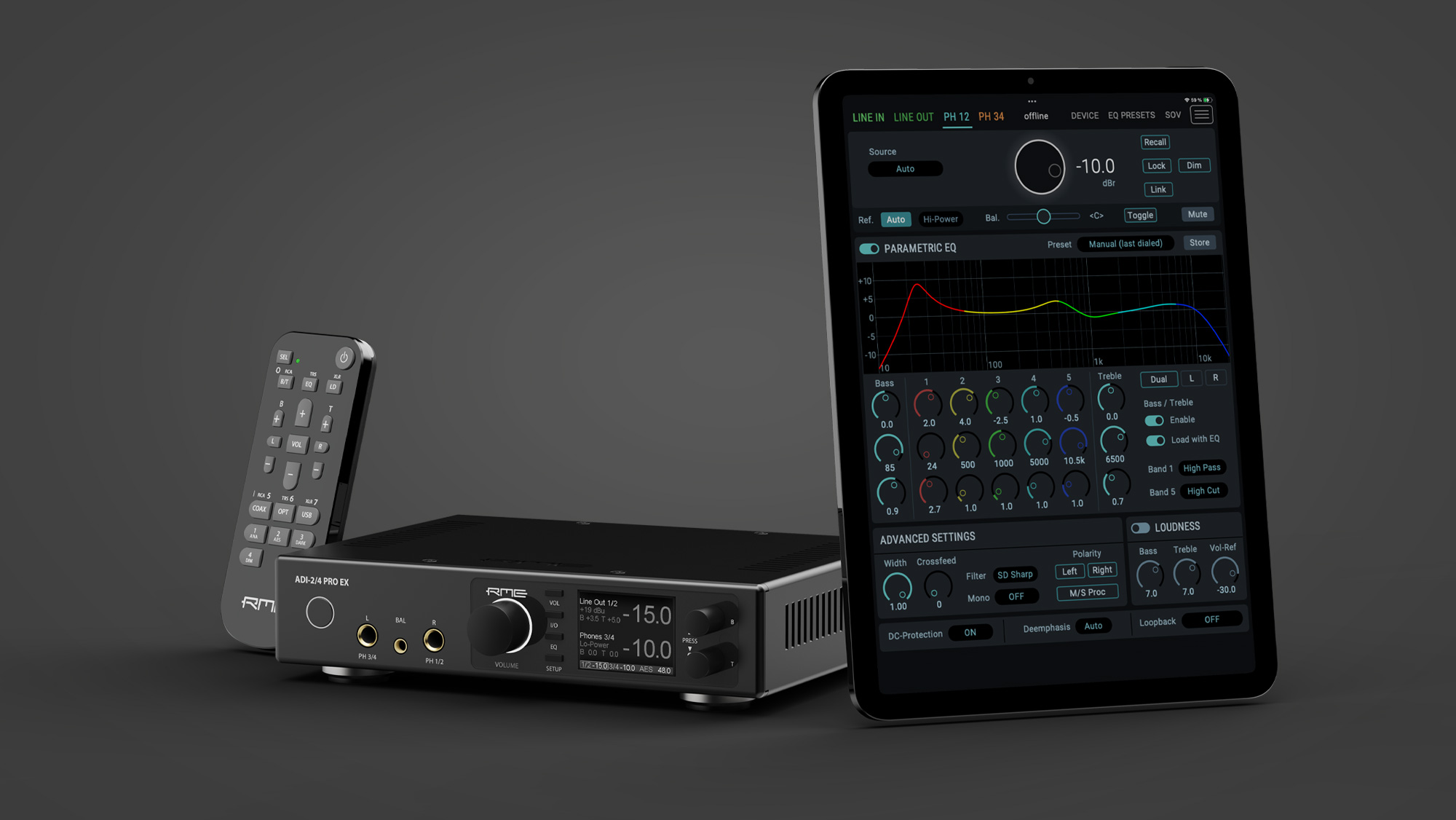
The ADI-2/4 Pro EX is a 2-channel analog input to digital and 4-channel digital to analog output converter in a half-rack (9.5") enclosure of 1 U height. Latest 32 bit / 768 kHz converters offer up to 127 dBA signal to noise ratio. Reference class tech specs throughout are combined with an unprecedented feature set. A powerful DSP adds all kinds of useful audio processing, including 5-band parametric EQ, fast Bass/Treble adjustment, Crossfeed, and a new concept in Loudness sound control.
The ADI-2/4 Pro EX includes two servo-balanced analog inputs on combo XLR / TRS jacks, two separate balanced and unbalanced outputs on XLR and TRS, two stereo Extreme Power headphone outputs on the front for easy balanced operation of all headphones, including IEMs via Pentaconn connector.
Also available are optical SPDIF I/O, which also understands ADAT, as well as coaxial SPDIF (RCA) and AES I/O (XLR) via an included breakout cable. This universal set of I/O options offers superior quality and flexible connectivity to those who take a no-compromise approach to audio.
With independent balanced outputs for Line and Phones, balanced phones no longer mutes the rear outputs. Balanced Line and Balanced Phones outputs can be used simultaneously, even with different sources/signals. The balanced TRS in the back can be fed from Line 1/2 or Phones 3/4 signal path, perfect for handling insert effects during the mastering process.
A high resolution IPS panel for the graphical operation surface eases operation even more, and displays further functions provided by the DSP, namely Peak level meters, a 30-band analyzer in DIGICheck biquad filter technology, and a State Overview screen listing the current states of SPDIF, AES, USB and clock.
As a computer interface the ADI-2/4 Pro EX offers a stereo (2 in / 2 out) and a multichannel mode (6 in / 8 out). Compatibility with macOS comes right out of the box. Under Windows the ADI-2/4 Pro EX uses RME's MADIface series driver, for full WDM and ASIO compatibility and highest performance.
Extreme Power Headphones - The new Reference in Accuracy and Dynamic Range
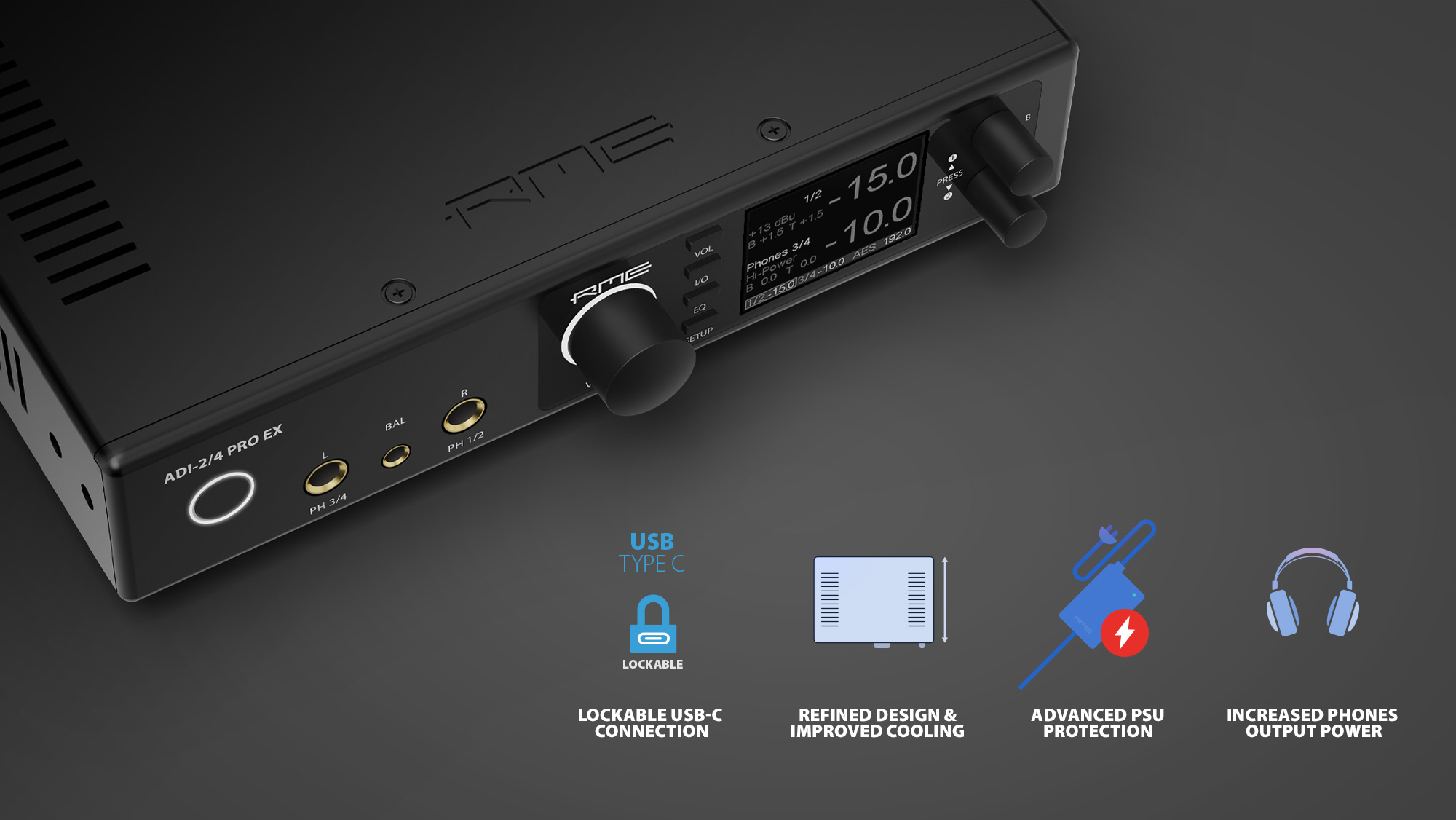
RME’s developed Extreme Power headphone stage is now further improved and delivers incredible more powerful headphone outputs. With a Special IEM mode, the Lower noise Extreme Power design adds additional IEM power states (High power, Low power, IEM) for full IEM compatibility.
All three phones outputs feature mute relay, over-current detection, DC protection, plug detection and DSP control, like auto assigning volume, volume ramp up, auto balanced mode, dual phones mode, user interaction at overload detection, and low impedance level meter auto scaling.
RME’s True Balanced mode realizes balanced phones operation independent from the XLR outputs. The device features 2 balanced input channels and 4 balanced output channels. Balanced headphones only use DAC channels 3/4 and the rear outputs can still output an independent signal via DAC 1/2. In True Balanced mode the ADI-2/4 Pro SE’s maximum output level rises to +7 dBu for IEM, +13 dBu for Low Power, +25 dBu for High Power. The signal to noise ratio stays unchanged.
Latest-Generation ESS Conversion
The ADI-2/4 Pro EX features RME's latest converter design with the ES9823Pro A/D converter and ES9039Q2M D/A converter, delivering improved signal-to-noise ratio, lower distortion and even greater conversion accuracy. Combined with RME's optimized analog circuitry and SteadyClock EX technology, the unit continues to provide transparent conversion and exceptional clock stability.
Enhanced Connectivity
A new lockable USB-C connector replaces the previous USB connection while maintaining USB 2.0 compatibility. The robust connector ensures a secure connection in mobile and studio environments, and a matching 1.8 m USB-C cable is included. The USB-C port is fully Class Compliant (UAC 2.0) a standard that is natively supported by operating systems like iOS, macOS, Linux and Windows 10 (since 1709), and is also used for firmware updates. Including an external switched power supply with lockable connector, the ADI-2/4 Pro EX can be easily powered from battery, opening up mobile applications as well as galvanically isolated use cases.
Advanced Protection Circuitry
The hardware has been further refined with several new protection features. A channel-independent DC protection circuit safeguards each headphone output individually, while a new active fuse-less power supply protection system detects incorrect polarity and overvoltage conditions before damage can occur. To improve installation flexibility, the ADI-2/4 Pro EX now includes a dedicated ground terminal for connecting turntables or providing an earth connection where required. The unit is also compatible with the new RM19-III rackmount adapter.
SteadyClock EX: Factory-Calibrated Clock Precision
SteadyClock FS has been expanded with factory calibration of the internal clock to an accuracy of ±1 ppm. In addition, users can adjust the internal sampling rate by ±50 ppm in 0.1 ppm increments, allowing precise synchronization with external equipment even without a dedicated word clock connection—an approach RME refers to as "Sync without Sync."
Extended Analog Performance
The analog input section has also been significantly extended. Reference levels now reach down to -35 dBu, allowing direct connection of dynamic microphones and supporting many additional recording applications. RIAA equalization is now available in Line mode (0 dB gain), enabling the use of external phono preamps while simplifying integration of moving coil cartridge systems. Selectable balanced input impedances of 94 kΩ and 47 kΩ provide optimal matching for balanced moving magnet cartridges. The higher SNR of the updated DAC further improves the already very low phones output noise floor with the lower reference levels, in both unbalanced and balanced mode.
Extended Linear Analog Range (ELAR)
The ADI-2/4 Pro EX features a refined version of its predecessor's (ADI-2/4 Pro SE) Extended Linear Analog Range (ELAR) technology, designed to preserve the maximum signal integrity throughout the complete analog signal path. ELAR combines the outstanding performance of RME’s latest converter architecture with carefully optimized filtering to achieve outstanding transparency and an exceptionally linear frequency response. The result is reference-grade audio quality that retains a remarkably analog purity while offering full DSP flexibility for versatile sound shaping.
Greater Monitoring Flexibility
The ADI-2/4 Pro EX further extends its flexible monitoring capabilities by allowing ADAT channels 3/4 to be selected directly as the headphone source. This provides additional routing options for digital monitoring and simplifies a variety of recording, mixing and playback workflows without requiring external routing solutions.
More Outstanding Features
DigiCheck - The Secret Weapon of High Resolution Audio Measurements
RME Audio interfaces not only provide you with a professional digital audio interface, but also with a free available software tool: DigiCheck, for metering, testing, measuring and analyzing digital audio streams.
ADI-2 Remote
The ADI-2 Remote software controller offers a seamless and intuitive interface for managing various parameters of the ADI- 2 series devices.
Extended Multi-Remote Support (MRC)
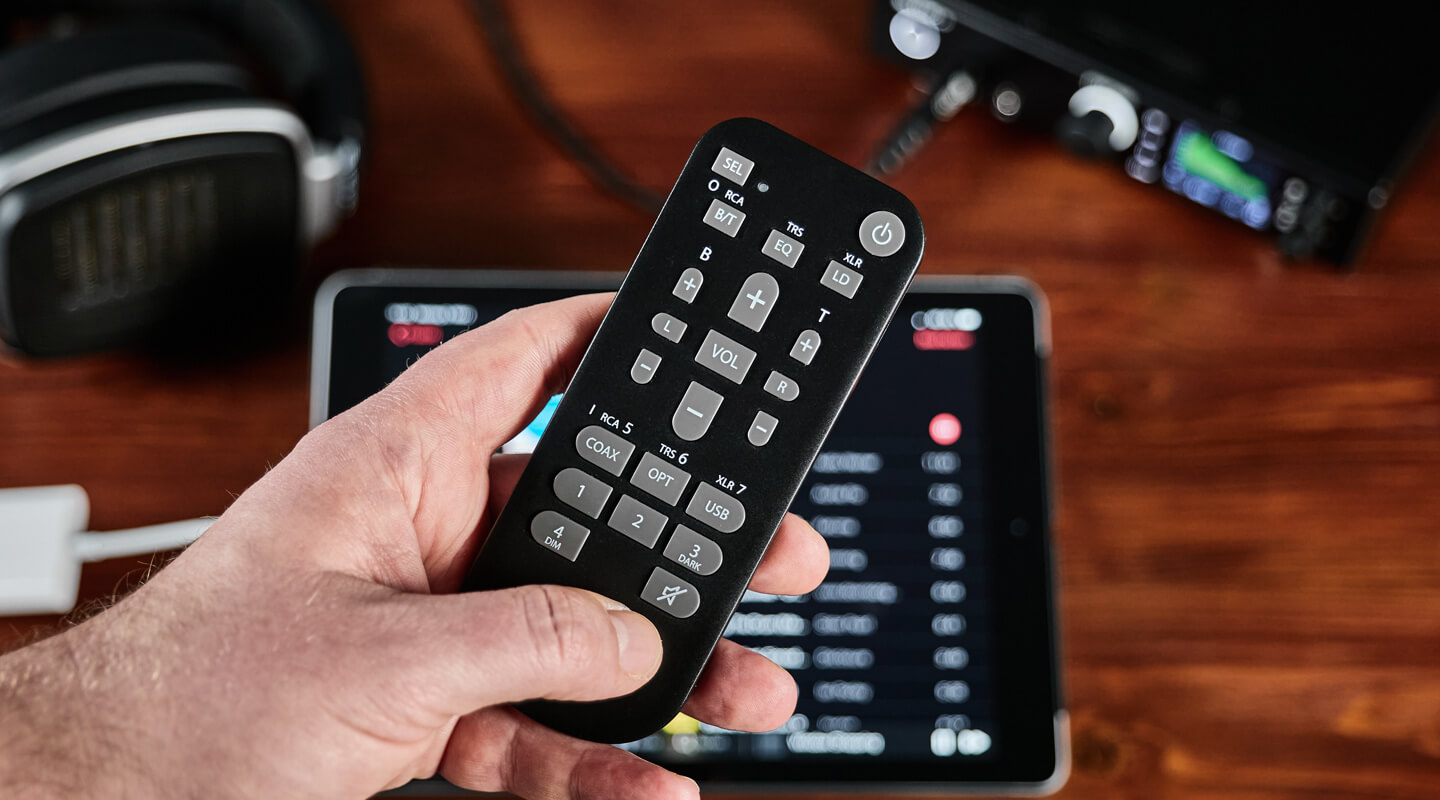
The ADI-2/4 Pro EX remote control provides buttons for standby on/off, volume, balance, bass and treble, input selection (optical, coaxial, USB), mute, on/off loudness, bass/treble and EQ. In addition, there are four programmable buttons that provide access to 61 different functions and commands for maximum flexibility. There is no other converter or comparable device with such a sophisticated, easy to use and at the same time versatile remote control.
Specs
ADI-2/4 Pro EX
Analog Inputs
XLR/TRS
- Input: XLR and 6.3 mm TRS jack, servo-balanced
- Input impedance @ 1 kHz, balanced: 94 kOhm, unbalanced: 47 kOhm
- Input impedance switchable, see RIAA BAL option
- Input sensitivity switchable +24 dBu, +19 dBu, +13 dBu, +7 dBu, +1 dBu @ 0 dBFS
- Digital Gain extends input sensitivity from -5 dBu down to -35 dBu
- Digital Trim Gain range: 0 dB up to +6 dB, in steps of 0.5 dB
- Signal to Noise ratio (SNR) @ +24 dBu: 125 dB (AES17), 127 dBA
- Signal to Noise ratio (SNR) @ +13/19 dBu: 124 dB (AES17), 126 dBA
- Signal to Noise ratio (SNR) @ +7 dBu: 123 dB (AES17), 125 dBA
- Signal to Noise ratio (SNR) @ +1 dBu: 121.5 dB (AES17), 123.5 dBA
- Signal to Noise ratio (SNR) @ -5 dBu (dig.): 117.5 dB (AES17), 119.5 dBA
- Signal to Noise ratio (SNR) @ -35 dBu (dig.): 87 dB (AES17), 89 dBA
- Frequency response* @ 44.1 kHz, -0.1 dB: 0.4 Hz – 20.5 kHz
- Frequency response* @ 96 kHz, -0.5 dB: 0.2 Hz – 44.5 kHz
- Frequency response* @ 192 kHz, -1 dB: 0.15 Hz – 91.5 kHz
- Frequency response* @ 384 kHz, -1 dB: 0.15 Hz – 175 kHz
- Frequency response* @ 768 kHz, -1 dB: 0.15 Hz – 290 kHz
- THD @ -1 dBFS: < -127 dB, 0.000045 %
- THD+N @ -1 dBFS: -119 dB, 0.000112 %
- Channel separation: > 130 dB @ 1 kHz
RIAA Mode via TS (unbalanced) and TRS/XLR (balanced)
- RIAA deviation 20 Hz – 20 kHz: < ±0.05 dB
- Input impedance switchable (option Bal. Impedance) 94 kOhm, 47 kOhm @ 1 kHz
- Input impedance unbalanced with Bal. Impedance 47k: 33 kOhm @ 1 kHz
- Input capacitance 150 pF
- Sensitivity: 0 dB: current Ref Level -15 dB, +14 dB: 20 mV, +20 dB: 10 mV
- Sensitivity: +26 dB: 5 mV, +32 dB 2.5 mV, +38 dB: 1.25 mV
- Additional 0 to +6 dB Gain in steps of 0.5 dB via Trim Gain
- Maximum input level @ 0 dB: current Ref Level
- Maximum input level @ +14 dB: 114 mV, -16.6 dBu
- Maximum input level @ +20 dB: 57 mV, -22.6 dBu
- Maximum input level @ +26 dB: 28.4 mV, -28.7 dBu
- Maximum input level @ +32 dB: 14.3 mV, -34.7 dBu
- Maximum input level @ +38 dB: 7.2 mV, -40.6 dBu
- Digital headroom in all Gains, related to sensitivity: 15 dB
- Signal to Noise Ratio (SNR), 20 Hz-20 kHz, +14/20 dB Gain: 88 dB, 92 dBA
- Signal to Noise Ratio (SNR), 20 Hz-20 kHz, +26 dB Gain: 80.5 dB, 85 dBA
- Signal to Noise Ratio (SNR), 20 Hz-20 kHz, +32 dB Gain: 74 dB, 78.5 dBA
- Signal to Noise Ratio (SNR), 20 Hz-20 kHz, +38 dB Gain: 68 dB, 73 dBA
- THD+N, 20 Hz-20 kHz, +14/+20 dB: -88 dB, 0.004 %
- THD+N, 20 Hz-20 kHz, +26 dB: -81.5 dB, 0.0084 %
- THD+N, 20 Hz-20 kHz, +32 dB: -74 dB, 0.019 %
- THD+N, 20 Hz-20 kHz, +38 dB: -69 dB, 0.035 %
Analog Outputs
1/2 XLR
- Output impedance @ 1 kHz @ +24/+19/+13 dBu: 200 Ohm
- Output impedance @ 1 kHz @ +7/+1 dBu: 100 Ohm
- Maximum Output Level: +26.5 dBu @ 0 dBFS
- Output level switchable +24 dBu, +19 dBu, +13 dBu, +7 dBu, +1 dBu @ 0 dBFS
- Signal to Noise ratio (SNR) @ +7/+13/19/24 dBu: 124 dB (AES17), 126 dBA
- Signal to Noise ratio (SNR) @ +1 dBu: 121 dB (AES17), 123 dBA
- Frequency response @ 44.1 kHz, -0.1 dB: 0 Hz – 20.5 kHz
- Frequency response @ 96 kHz, -0.5 dB: 0 Hz – 45.2 kHz
- Frequency response @ 192 kHz, -1 dB: 0 Hz – 91 kHz
- Frequency response @ 384 kHz, -1 dB: 0 Hz – 183 kHz
- Frequency response @ 768 kHz, -3 dB: 0 Hz – 350 kHz
- THD @ 0 dBFS: < -130 dB, 0.0000316 %
- THD+N @ 0 dBFS: -119 dB, 0.00011 %
- Channel separation: > 130 dB @ 1 kHz
1/2 TRS (rear)
As 1/2 XLR, but:
- Output: 6.3 mm TRS jack, impedance-balanced
- Output impedance @ 1 kHz: balanced 200 Ohm, unbalanced 100 Ohm
- Maximum output level: +21.5 dBu @ 0 dBFS
- Signal to Noise ratio (SNR) @ +19 dBu: 124 dB (AES17), 126 dBA
- Signal to Noise ratio (SNR) @ +7/+13 dBu: 122 dB (AES17), 124 dBA
- Signal to Noise ratio (SNR) @ +1 dBu: 118.5 dB (AES17), 120.5 dBA
Phones 1/2, Phones 3/4
As Output 1/2 TRS, but:
- Output: 6.3 mm TRS stereo jack, unbalanced
- Output impedance: 0.1 Ohm
- Maximum output level: +21.5 dBu @ 0 dBFS
- Output level at 0 dBFS, Ref Level +19 dBu, load 100 Ohm or up: +21.5 dBu (9.2 V)
- Signal to Noise ratio (SNR) @ +19 dBu (Hi-Power): 124 dB (AES17), 126 dBA
- Signal to Noise ratio (SNR) @ +7 dBu (Lo-Power): 122 dB (AES17), 124 dBA
- Signal to Noise ratio (SNR) @ +1 dBu (IEM): 120 dB (AES17), 122 dBA
- Minimum load impedance IEM @ +1 dBu: 4 Ohm
- Minimum load impedance Lo-Power @ +7 dBu: 8 Ohm
- Minimum load impedance Hi-Power @ +19 dBu: 24 Ohm
- Maximum output power @ 0.1% THD+N, 300 Ohm: 0,288 W per channel*
- Maximum output power @ 0.1% THD+N, 32 Ohm: 2.4 W per channel*
- Maximum output power @ 0.1% THD+N, 16 Ohm: 1.93 W per channel*
- THD @ +20 dBu, 32 Ohm load (1.9 Watts): -124 dB, 0.000057 %
- THD+N @ + 20 dBu, 32 Ohm load (1.9 Watts): -118 dB, 0.00011 %
- Channel separation 20 Hz – 20 kHz: 80 dB @ 32 Ohm
Balanced Phones mode
As before, but:
- Output impedance: 0.2 Ohm
- Maximum output level: +27.5 dBu (18.4 V) @ 0 dBFS
- Output levels switchable: IEM +7 dBu, Lo-Power +13 dBu, Hi-Power +25 dBu
- Output levels switchable: IEM 1.73 V, Lo-Power 3.46 V, Hi-Power 13.8 V
- Signal to Noise ratio (SNR) @ Hi-Power: 124 dB (AES17), 126 dBA
- Signal to Noise ratio (SNR) @ Lo-Power: 123 dB (AES17), 125 dBA
- Signal to Noise ratio (SNR) @ IEM: 122 dB (AES17), 124 dBA
- Minimum load impedance IEM @ +7 dBu: 8 Ohm
- Minimum load impedance Lo-Power @ +13 dBu: 12 Ohm
- Minimum load impedance Hi-Power @ +25 dBu: 40 Ohm
- Maximum output power @ 0.1% THD+N, 300 Ohm: 1,15 W per channel*
- Maximum output power @ 0.1% THD+N, 32 Ohm: 3.85 W per channel*
- Maximum output power @ 0.1% THD+N, 16 Ohm: 1.93 W per channel*
- Channel separation: > 130 dB @ 1 kHz
Digital Inputs
General
- Lock Range: 28 kHz – 200 kHz
- Jitter suppression: > 50 dB (> 1 Hz)
- Accepts Consumer and Professional format
AES/EBU
- 1 x XLR, transformer-balanced, galvanically isolated, according to AES3-1992
- Input sensitivity 1.0 Vpp
SPDIF coaxial
- 1 x RCA, transformer-balanced, according to IEC 60958
- High-sensitivity input stage (< 0.3 Vpp)
- AES/EBU compatible (AES3-1992)
SPDIF optical
- 1 x optical, according to IEC 60958
- ADAT compatible
Digital Outputs
AES/EBU
- 1 x XLR, transformer-balanced, galvanically isolated, according to AES3-1992
- Output level 2.7 Vpp
- Format Professional according to AES3-1992 Amendment 4
- Single Wire mode, sample rate 44 kHz up to 200 kHz
SPDIF coaxial
- 1 x RCA, according to IEC 60958
- Output level 0.75 Vpp
- Format Consumer SPDIF according to IEC 60958
- Single Wire mode, sample rate 44 kHz up to 200 kHz
SPDIF optical
- 1 x optical, according to IEC 60958
- Format Consumer (SPDIF) according to IEC 60958
- Sample rate 44 kHz up to 200 kHz
Digital
- Clocks: Internal, AES In, SPDIF In, ADAT In
- Internal clock accuracy: ±1 ppm
- Jitter suppression of external clocks: > 50 dB (> 1 Hz)
- Effective clock jitter influence on AD and DA conversion: near zero
- PLL ensures zero dropout, even at more than 100 ns jitter
- Additional Digital Bitclock PLL for trouble-free varispeed ADAT operation
- Supported sample rates for external clocks: 32 kHz up to 200
- Internally supported sample rates: 44.1 kHz up to 768 kHz
General
- Included power supply: external switching PSU, 100 - 240 V AC, 3.3 A, 40 Watts
- Standby power consumption DC 12 V: 170 mW
- Standby power consumption AC 230 V: 280 mW
- Idle power consumption: 14 Watts, Max. power consumption: 30 Watts
- Idle current at 12 V: 1.16 A
- Under voltage detection: < 9.0 V
- Over voltage disconnection: > 16.5 V
- Dimensions (WxHxD): 215 x 44 x 160 mm (8.5" x 1.73" x 6.3")
- Weight: 1.2 kg ( 2.2 lbs)
- Temperature range: +5° up to +40° Celsius (41° F up to 112°F)
- Relative humidity: < 75%, non condensing
All specifications are subject to change without notice.
Drivers
ADI-2/4 Pro EX
Update to version: (*latest changes)
MADIface XT: USB 3/2 191, PCIe 56, DSP 42
MADIface XT II: USB 3/2 324, DSP 61, CC 15
MADIface USB, Hw Rev 6: 25, CC 4
MADIface USB, Hw Rev 7: 102, CC 103
MADIface Pro: 73
OctaMic XTC: USB 47, DSP 26
ADI-2/4 Pro SE (Hw Rev 6): FPGA 73, DSP 40
ADI-2/4 Pro SE (Hw Rev 7): FPGA 210, DSP 40
ADI-2/4 Pro EX: FPGA 324, DSP 106
ADI-2 Pro Series (Hw Rev 6): FPGA 270, DSP 130*
ADI-2 Pro EX (Hw Rev 7): FPGA 418, DSP 130*
ADI-2 DAC FS: FPGA 81, DSP 62
Digiface USB, Hw Rev X: 18, CC 2
Digiface USB, Hw Rev G: 35, CC 7
Fireface UFX II, Hw Rev A: USB 26, DSP 30, CC 15
Fireface UFX II, Hw Rev E: USB 115, DSP 30, CC 112
Fireface UFX II, Hw Rev 7: USB 206, DSP 30, CC 208
Fireface UFX III: USB 21 DSP 25 CC 47
Digiface Dante: 68 CC 21
Digiface Ravenna: 55 CC 3*
Digiface AES: USB 47, MCU 17, CC 11
USB I/O: USB 10 CC 14
USB.MADI: USB 18, CC 13*
Update to firmware: (* latest change)
MADIface XT: USB 191 PCIe 56 DSP 42
MADIface XT II: USB 3/2 323, DSP 61, CC 17
MADIface USB: 25 CC4 (6), 102 CC 103 (7)
MADIface Pro: 73
OctaMic XTC: 47/26
ADI-2 Pro series: FPGA 270, DSP 130*
ADI-2 Pro EX: FPGA 418, DSP 130
ADI-2 DAC series: FPGA 81, DSP 62
ADI-2/4 Pro SE (6): FPGA 73, DSP 40
ADI-2/4 Pro SE (7): FPGA 210, DSP 40
ADI-2/4 Pro EX: FPGA 324, DSP 106
UFX II: USB 26 DSP 30 CC 15 (A), USB 115 DSP 30 CC 112 (E), USB 206 DSP 30 CC 208 (7)
Fireface UFX III: USB 21 DSP 25 CC 47
UFX+: USB 55 DSP 62 Thunderbolt 112 (A), USB 72 DSP 62 Thunderbolt 167 (E)
Digiface USB: 18 CC 2 (X), 35 CC 7 (G)
Digiface AVB: 273*
Digiface Dante: 68 CC 21
Digiface Ravenna: 55
Digiface AES: USB 47 MCU 17 CC 11
USB I/O: USB 10, CC 14
USB.MADI: USB 18, CC 13*
Driver for Windows 10 / 11, Intel x64 and Arm, version 1.0.26. Supports Intel Windows 10 or up 64 bit, and Windows 11 Arm systems, with both WDM and ASIO. Updated installer. See readme for details.
Driver for Windows 10 / 11, Intel x64 and Arm, version 1.0.26. Supports Intel Windows 10 or up 64 bit, and Windows 11 Arm systems, with both WDM and ASIO. Updated installer. See readme for details.
Universal binary, runs natively on Intel and Mx machines. DigiCheck NG V 0.93 requires macOS 10.13 (High Sierra) or up.
Differences to v 4.53: EBU R-128 Meter. Surround Audio Scope with ITU weighting. Simultaneous usage of multiple cards in all functions. Displays fully configurable (e.g. channel selection). Multichannel Level Meter freely configurable. MMCSS for Vista. Many improvements on surface and internal operation. Supports all current interfaces plus DIGI 9636/52. DIGI32 series and DIGI96 series are no longer supported. (10/05/2020).
V596 adds compatibilty for HDSPe MADI FX and XT with DK firmware.
Manuals
ADI-2/4 Pro EX
ADI-2/4 Pro EX manual, version 2.0, 10/2026